Academic Staff
Dr. Paul Tremper

Profile
My research focuses on machine learning and computational methods for modelling and understanding complex systems. With a background in theoretical physics (Dr. rer. nat.), I am particularly interested in researching how mathematical structure and domain-specific knowledge can be incorporated into data-driven models of complex systems.
My work spans probabilistic machine learning, Bayesian inference, neural networks and neural operators, with applications in environmental sensing, spatio-temporal modelling, inverse modelling and computational fluid dynamics. I am especially interested in approaches that combine the flexibility of machine learning with the interpretability and structure of mathematical and physical models.
Short CV
- since 2019 Scientific Researcher at TECO
- 2018 Dr. rer. nat. Dissertation in Theoretical Particle Physics
- 2014 - 2018 PhD student at TTP (Institute for Theoretical Particle Physics) at KIT
- 2014 Graduation with Diplom (Master equivalent) from Karlsruhe Institute of Technology (KIT)
- until 2014 Student of Physics at Karlsruhe Institute of Technology (KIT)
Research Interests
- Scientific Machine Learning: Machine learning methods for modelling, simulating, and understanding complex scientific and physical systems.
- Physics-Informed and Structure-Aware Machine Learning: Incorporating mathematical structure, physical principles, and domain knowledge into machine learning models.
- Probabilistic Modelling and Bayesian Inference: Gaussian processes, uncertainty quantification, statistical inference, and inverse problems.
- Neural Networks and Neural Operators: Deep learning architectures, operator learning, and surrogate models for scientific computing and simulation.
- Environmental and Spatio-Temporal Modelling: Data-driven modelling of environmental processes, sensor networks, atmospheric dispersion, and computational fluid dynamics.
Projects

SmartAQnet
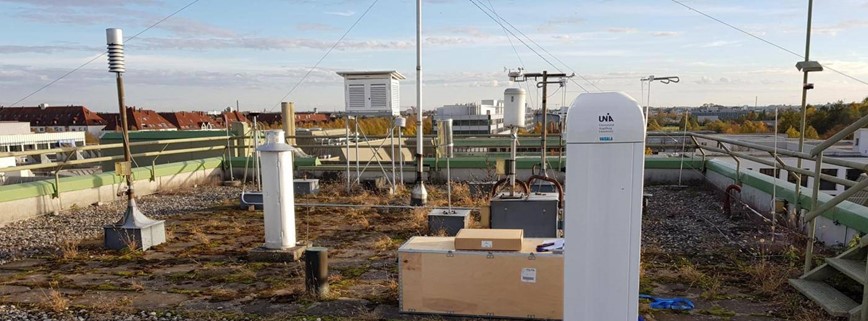
“SmartAQnet” addresses urban air-quality and associated health-related quality-of-life issues by combining existing data sets with a networked mobile measurement strategy.
AI-Driven Autocalibration of a Heterogeneous Sensor Network
The SDI-C Microproject "AI-Driven Autocalibration of a Heterogeneous Sensor Network" explores how to automate the calibration of low-cost environmental sensors using Machine Learning. By leveraging a dense, heterogeneous network of reference stations—ranging from low-cost sensors to official monitoring stations—this project aims to enable cities to monitor air quality comprehensively and cost-effectively. The goal is to validate AI-driven, remote calibration approaches that eliminate the need for manual, time-consuming processes, making real-time air quality tracking accessible even for Citizen Science applications.

HEPTA – Topic area 3: Smart Cities
HEPTA (Helmholtz European Partnership for Technological Advancement) promotes cooperation between Aristotle University of Thessaloniki (AUTh) and the Karlsruhe Institute of Technology (KIT) in the development of sustainable technologies in the fields of air quality, atmospheric physics, biomass and smart cities.

Nuberisim2AI
The SDI-S Microproject "Nuberisim2AI" leverages artificial intelligence to improve on flow-induced noise prediction by shortening time-consuming fluid simulations. Traditionally, analyzing noise sources requires up to 14 days on high-performance computers. This project aims to use AI to extend existing flow simulation time series by up to 50%, thereby reducing the overall analysis time by up to 75%. By enabling faster and more efficient simulations, it empowers engineers to optimize device designs for noise reduction while maintaining performance—supporting applications in aerospace, automotive, and industrial systems.
Publications
Ioannidis, G.; Bouloti, N.; Tremper, P.; Li, C.; Boikos, C.; Rapkos, N.; Riedel, T.; Dal Maso, M.; Ntziachristos, L.
2026. Atmospheric Pollution Research, 17 (8), Art.Nr: 103096. doi:10.1016/j.apr.2026.103096
Ioannidis, G.; Tremper, P.; Li, C.; Riedel, T.; Rapkos, N.; Boikos, C.; Ntziachristos, L.
2025. Atmosphere, 16 (3), 326. doi:10.3390/atmos16030326
Gkirmpas, P.; Tsegas, G.; Ioannidis, G.; Tremper, P.; Riedel, T.; Chourdakis, E.; Vlachokostas, C.; Moussiopoulos, N.
2025. Atmosphere, 16 (10), Art.-Nr.: 1184. doi:10.3390/atmos16101184
Ioannidis, G.; Tremper, P.; Li, C.; Riedel, T.; Rapkos, N.; Boikos, C.; Ntziachristos, L.
2024. Atmosphere, 15 (9), 1056. doi:10.3390/atmos15091056
Ioannidis, G.; Li, C.; Tremper, P.; Riedel, T.; Ntziachristos, L.
2024. Atmosphere, 15 (1), Art.-Nr.: 113. doi:10.3390/atmos15010113
Tremper, P.; Riedel, T.
2023. 37th EnviroInfo 2023, Garching, 11th-13th October 2023, 219 – 229, Gesellschaft für Informatik (GI). doi:10.18420/env2023-020
Li, C.; Budde, M.; Tremper, P.; Schäfer, K.; Riesterer, J.; Redelstein, J.; Petersen, E.; Khedr, M.; Liu, X.; Köpke, M.; Hussain, S.; Ernst, F.; Kowalski, M.; Pesch, M.; Werhahn, J.; Hank, M.; Philipp, A.; Cyrys, J.; Schnelle-Kreis, J.; Grimm, H.; Ziegler, V.; Peters, A.; Emeis, S.; Riedel, T.; Beigl, M.
2022. ProScience, 8. doi:10.14644/dust2021.001
Schäfer, K.; Budde, M.; Cyrys, J.; Emeis, S.; Gratza, T.; Grimm, H.; Hank, M.; Kowalski, M.; Pesch, M.; Peters, A.; Philipp, A.; Riedel, T.; Riesterer, J.; Schnelle-Kreis, J.; Tremper, P.; Uhrner, U.; Werhahn, J.; Ziegler, V.; Beigl, M.
2021. Gefahrstoffe, Reinhaltung der Luft, 81 (9-10), 353–361
Janßen, J.; Riedel, T.; Tremper, P.
2021. Workshop: 2. Workshop Künstliche Intelligenz in der Umweltinformatik (KIUI-2021), 321–331, Gesellschaft für Informatik (GI). doi:10.18420/informatik2021-026
Tremper, P.; Riedel, T.; Budde, M.
2021. Workshop: 2. Workshop Künstliche Intelligenz in der Umweltinformatik (KIUI-2021), 269–286, Gesellschaft für Informatik (GI). doi:10.18420/informatik2021-022
Schlund, R.; Riesterer, J.; Köpke, M.; Kowalski, M.; Tremper, P.; Budde, M.; Beigl, M.
2021. Science and Technologies for Smart Cities – 6th EAI International Conference, SmartCity360°, Virtual Event, December 2-4, 2020, Proceedings. Ed.: S. Paiva, 596–614, Springer International Publishing. doi:10.1007/978-3-030-76063-2_40
Pescara, E.; Tremper, P.; Formanek, J.; Hefenbrock, M.; Huang, Y.; Ravivanpong, P.; Riesterer, J.; Wang, L.; Wolff, I.; Zhou, Y.; Beigl, M. (Eds.)
2020. Karlsruher Institut für Technologie (KIT)
Budde, M.; Riesterer, J.; Köpke, M.; Tremper, P.; Riedel, T.
2019. Mid-term and 1st International Networking Workshop of the SmartAQnet Project : December 4th and 5th 2018, Munich. Ed.: M. Budde, 3, Karlsruher Institut für Technologie (KIT)