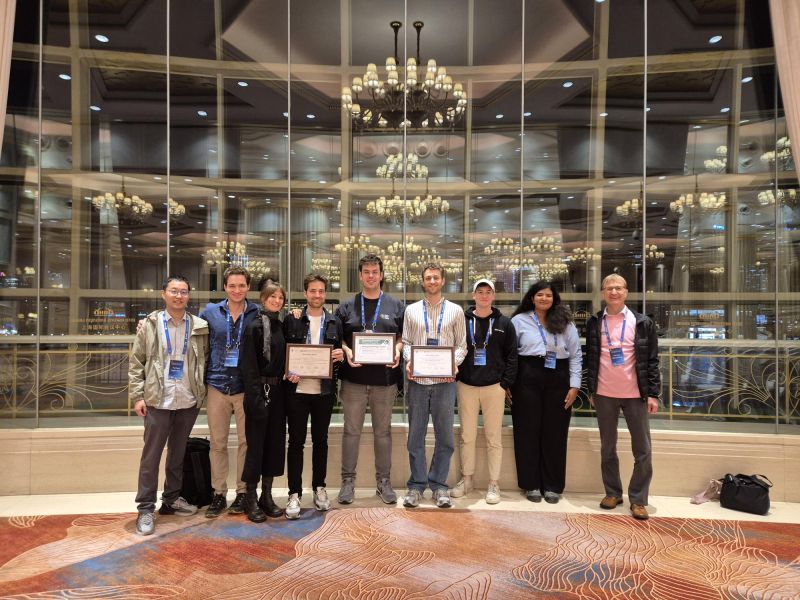
Looking back at a very successful week at #UbiCompISWC26 in Shanghai. It was great to see the breadth of excellent research, demos, and discussions across the ubiquitous and wearable computing community. Many thanks to everyone who helped organize the conference and make the week possible.
I am especially happy how the #TECO team showed its work across the conference program and how they presented their many contributions on stage and in the booth. Moreover, I am proud that Tobias Röddiger and colleagues received an #IMWUT Distinguished Paper Award, Philipp Lepold and colleagues the #ISWC Best Paper Award, and Jonas Hummel and colleagues the #UbiComp Best Demo Award. These recognitions are a reflection of the dedication and teamwork behind the projects. Congratulations to everyone involved, including all co-authors and collaborators.
Let's keep on working hard - #TECO is looking forward to #UbiCompISWC27 in #Seoul.
📢 We at #TECO are proud to announce that three of our papers have been accepted to #ISWC26 at #UbiCompISWC26 in #Shanghai! This year, our contributions span personalized #HumanActivityRecognition, robust evaluation for wearable health sensing, and earbud-based cardiac monitoring.
---
🏃 Personalized activity recognition with just seconds of calibration
“BayaHAR: Lightweight Bayesian Few-Shot User Adaptation for On-Device Personalized Human Activity Recognition” – Maximilian Burzer et al.
With #BayaHAR, we introduce a lightweight, gradient-free approach for personalizing pretrained HAR models directly on wearable devices. Bayesian prototype updates enable adaptation from very little user-specific data: with only three seconds of calibration per activity, supervised adaptation improved macro-F1 by 2.76 to 33.44 percentage points across four datasets, while requiring no backpropagation on-device.
📄 Preprint: https://lnkd.in/dS7Sa89j
---
🩸 When promising glucose-estimation results do not generalize
“Reassessing the Feasibility of PPG-Based Non-Invasive Blood Glucose Level Estimation” – Supraja Ramesh et al.
We systematically reassess five representative methods for estimating blood glucose from #PPG using a reproducible evaluation pipeline. While models appear competitive with random train-test splits, their performance largely collapses when evaluated on unseen participants. At the same time, commonly used clinical error-grid metrics still report more than 90% acceptable predictions – even for a simple baseline – highlighting why careful evaluation is essential before assessing real-world utility.
📄 Preprint: https://lnkd.in/dQg5jvjY
---
❤️ Touch your earbud to capture an ECG
“Finger-to-Ear ECG: Systematic Evaluation of an Earbud-Based Cardiac Monitoring Approach” – Philipp Lepold et al.
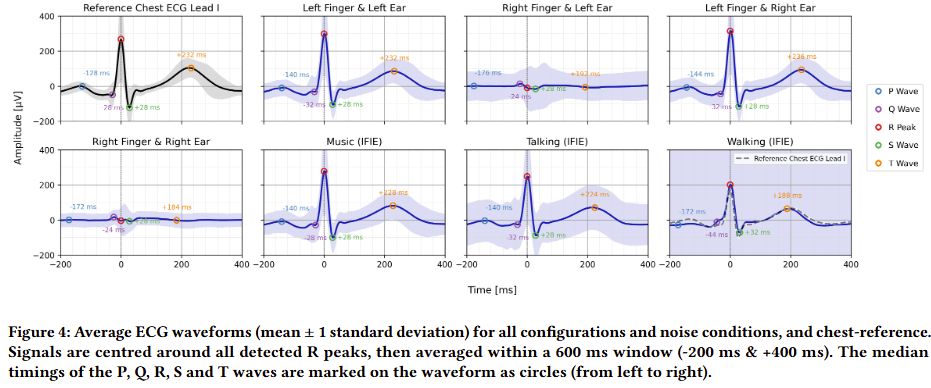
#FingerToEarECG combines an in-ear electrode with a finger-contact electrode on the earbud housing for opportunistic cardiac sensing. In a study with 30 participants, left-finger configurations achieved R-peak detection F1-scores above 99% while preserving important ECG morphology, demonstrating the potential of a simple earbud touch interaction for high-quality cardiac monitoring.
📄 Preprint: https://lnkd.in/dJGYuK8w
---
#ISWC #WearableComputing #WearableTech #HumanActivityRecognition #PersonalizedAI #PPG #Glucose #DigitalHealth #Earables #CardiacMonitoring #MachineLearning #HumanComputerInteraction #TECO